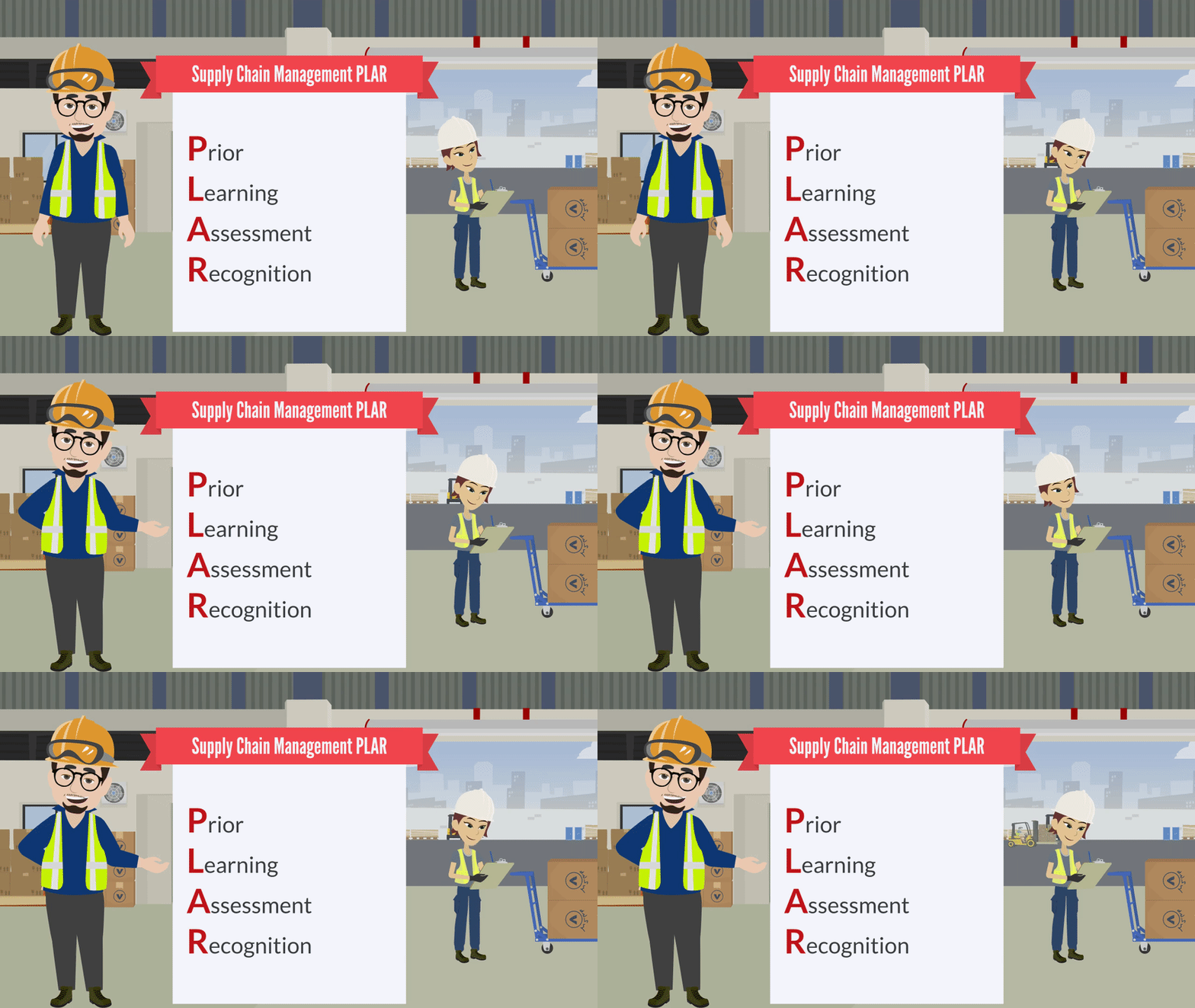
SUPPLY CHAIN MANAGEMENT PLAR
ONLINE ASSESSMENT PLATFORM
UX Research | Service Design | Research Coordination (2023–2025)
NorQuest College, Faculty of Research and Academic Innovation
Description: NorQuest College partnered with Supply Chain Canada to launch a Government of Alberta–funded pilot supporting internationally trained newcomers to validate their supply chain experience through a digital Prior Learning Assessment & Recognition (PLAR) platform.
I joined a lean, high-impact team as UX Researcher and Research Coordinator, leading mixed-method research, usability evaluation, and service design across a two-year pilot
Overview
Challenge: Despite strong employment opportunities in Alberta’s supply chain industry, skilled newcomers are underrepresented in this sector, facing unemployment and underemployment.
Solution: Developed targeted workforce integration interventions and supports: digital PLAR assessment platform to validate existing supply chain knowledge, skills, and training paired with career coaching, industry membership, and work placements.
My Role
UX Researcher & Research Coordinator
(With significant service design and content development)
Designed qualitative and quantitative research tools (surveys, interview protocols, usability scripts)
Recruited 68% of all program participants into the research study
Led moderated usability testing (remote + proctored)
Conducted behavioural observation during live assessments
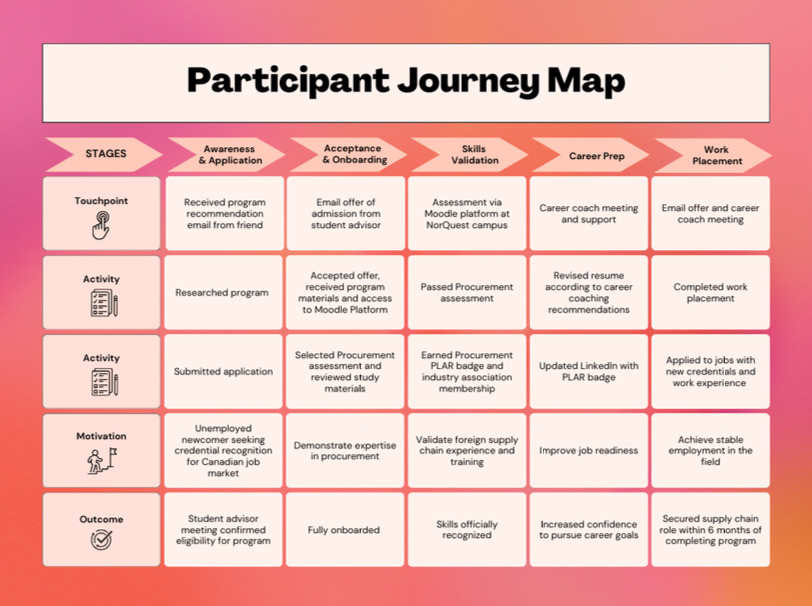
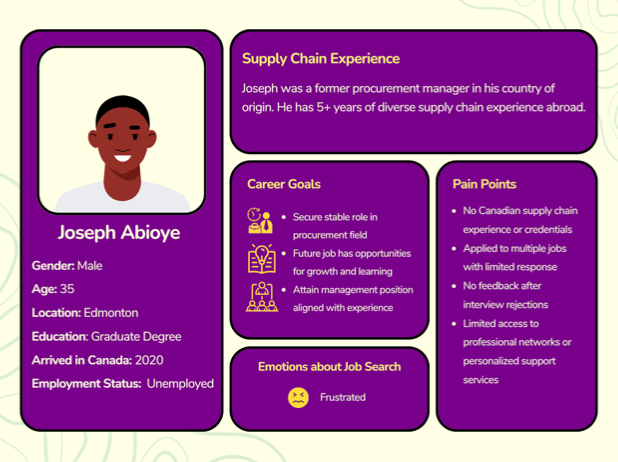
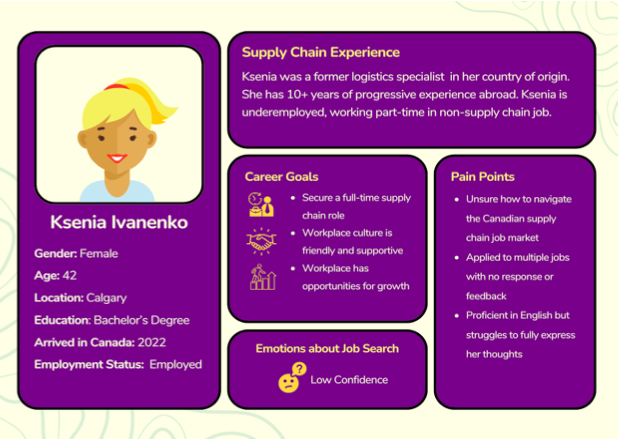
Developed participant personas and a full service journey map
Evaluated accessibility and cognitive load
Synthesized findings into usability and academic reports (forthcoming)
Wrote and secured Research Ethics Board (REB) approval
Developed module content and animated assessment videos
Produced data visualizations and graphics for stakeholder reporting
Tools & Platforms
Research & Surveys: Qualtrics
Design & Prototyping: Figma, Canva
Content Development: Vyond
Learning Platform: Moodle
Workflow & Documentation: Microsoft 365
Research Design
Quantitative and Qualitative Research Methods/Evaluation
I designed a full evaluation framework integrating:
Semi-structured participant interviews
Moderated usability testing
Remote assessment behavioural observation (screen + camera via Teams)
Pre & post assessment surveys
Post-program survey
Assessment result data
Government intake forms and staff notes
Usability Methodology
Participants completed real assessment tasks (intro video + scenarios 1–3 covering all question types).
I documented:
Navigation friction
Behavioural cues (hesitation, cognitive strain, self-talk)
Accessibility barriers
Technical breakdowns
Post-task emotional response
Issues were coded by severity: Critical, Serious, Moderate, Minor, with actionable design recommendations.
Service Design
Beyond platform usability, I mapped the entire participant journey:
Impact
68% recruitment rate into research (exceptionally high engagement)
75% of participants passed at least one assessment, validating prior experience
92% program satisfaction
Accessibility improvements implemented (captions, visual clarity, UX refinements)
Technical errors resolved prior to scale
Assessment questions revised to reduce cognitive overload
Identified need for a condensed refresher course (simplified terminology + foundational concepts)
Recommendations adopted across platform and service touchpoints
OTHER PROJECTS

Protectress VR Virtual Reality Experience